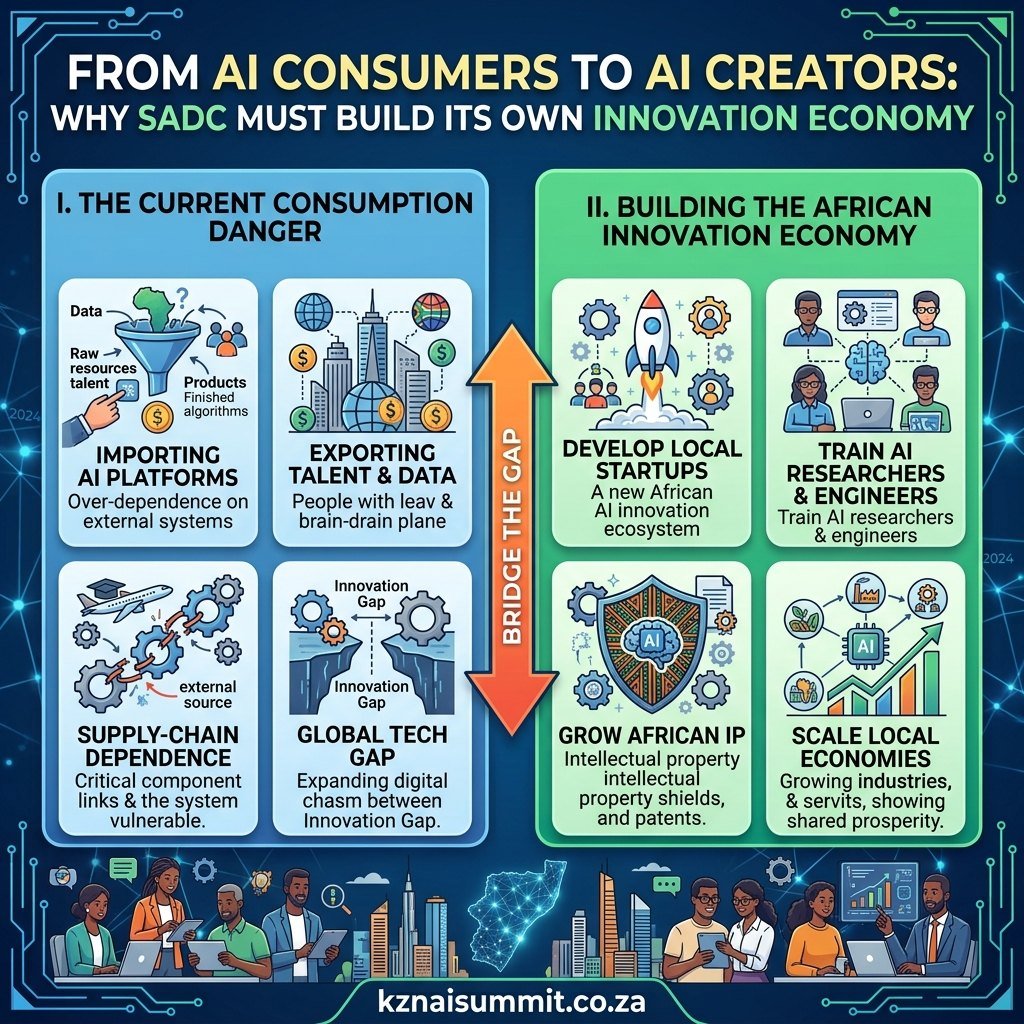
Artificial intelligence is becoming one of the most important technologies shaping the global economy.
It is changing how businesses operate, how governments deliver services, how people work, how students learn and how new companies are created.
Across the world, governments and corporations are investing billions into AI infrastructure, research, computing power, startups and talent.
SADC is part of this transformation.
But there is a question the region needs to confront urgently.
Will SADC become a major creator of the AI economy, or will it remain primarily a consumer of technologies created elsewhere?
The answer will have consequences far beyond technology.
It will affect jobs. It will affect investment. It will affect the competitiveness of local businesses. It will affect the development of young people. It will affect digital sovereignty.
And ultimately, it will affect who owns a meaningful part of Africa's future economy.
The Consumer Trap
There is nothing wrong with African businesses and governments adopting global AI platforms.
In fact, access to powerful AI technologies is already helping businesses and individuals accomplish things that would have been difficult or expensive only a few years ago.
- A small business can use AI to develop marketing material.
- A student can use AI as a learning assistant.
- A farmer can use technology to analyse information.
- A government department can explore ways of improving public services.
- A startup can use AI to develop a prototype in days rather than months.
These are important opportunities.
But adoption alone does not create an AI economy.
If SADC spends years consuming AI platforms developed in other countries while its brightest engineers, researchers and entrepreneurs leave for opportunities elsewhere, the region may find itself participating in the AI economy without owning much of it.
That is the danger.
We could become excellent users of technologies that we did not create, do not own and cannot fully control.
Talent Cannot Be Africa's Export Model
Africa has no shortage of intelligent, ambitious and technically capable young people.
The continent is producing developers, engineers, data scientists, researchers, entrepreneurs and technology professionals who can compete internationally.
But talent alone is not enough.
If the best African talent is trained locally and then recruited by companies headquartered elsewhere, Africa may end up subsidising the global technology industry with its human capital.
The question is therefore not simply: how do we train more AI specialists?
It should also be: how do we create an environment where those specialists can build companies, develop intellectual property and create jobs here?
That is where the innovation economy becomes important.
What Does an African AI Innovation Economy Look Like?
An AI innovation economy is much bigger than people using AI tools.
It includes:
- AI startups.
- African intellectual property.
- Research and development.
- AI infrastructure.
- Data and computing capabilities.
- Investment capital.
- Universities and research institutions.
- AI skilled workers.
- Corporate innovation.
- Government procurement.
- Regional markets.
These components reinforce each other.
Universities produce talent and research. Entrepreneurs turn research into products. Investors provide capital. Corporates become customers. Government creates enabling policies and markets. Successful startups create jobs and train more people. Those businesses then expand into other African markets.
That is how an ecosystem develops.
Why SADC Has a Unique Opportunity
SADC should not think about AI only from the perspective of individual countries.
The region represents a much larger opportunity when considered collectively.
Different SADC countries have different strengths.
- Some have strong financial sectors.
- Some have significant mineral resources.
- Some have agricultural economies.
- Some have growing technology ecosystems.
- Some have major tourism industries.
- Some have expanding telecommunications infrastructure.
- Some have strong universities and research institutions.
And all have problems that could potentially benefit from AI.
Agriculture, Healthcare, Education, Financial inclusion, Mining, Energy, Logistics, Tourism, Manufacturing, Climate resilience, Public administration, Cybersecurity.
These are not theoretical opportunities.
They are real problems affecting millions of people.
They are also potential markets for African technology companies.
Africa Should Build AI for African Problems
There is an important distinction between using AI and building AI solutions around African realities.
An AI system developed for a highly digitised market may not automatically work perfectly in a market where connectivity is limited.
A customer service solution designed for English speaking customers may not adequately address the linguistic diversity of Africa.
A financial technology solution designed around one country's banking infrastructure may not work across another country's informal economy.
African agriculture has its own environmental and operational realities. African cities have their own transport and infrastructure challenges. African small businesses have their own constraints.
This creates an enormous innovation opportunity.
Africa’s challenges can become the starting point for African AI companies.
The objective should not be to isolate Africa from global technology.
It should be to combine global AI advances with African knowledge, talent and entrepreneurship.
The Startup Opportunity
- Imagine a young developer in Lusaka building an AI solution for agricultural forecasting.
- Imagine a team in Durban developing intelligent tools for small businesses.
- Imagine researchers in Harare working on AI applications for healthcare.
- Imagine entrepreneurs in Maputo developing solutions for logistics.
- Imagine innovators in Gaborone developing technology for sustainable mining.
Now imagine these companies being able to access customers across the entire SADC region.
That is where the scale becomes exciting.
A startup does not need to build a solution for only one city or one country. A regional market can provide the opportunity to test, improve and scale African technology.
A successful SADC startup could eventually become an African company.
And an African company could eventually compete globally.
From Hackathon to Company
This is why hackathons can be far more important than many people realise.
A hackathon should not simply be a competition where developers build something over a weekend, receive a prize and return home.
When designed properly, a hackathon can become the beginning of an innovation pipeline.
- A problem is identified.
- Teams form.
- Ideas are developed.
- Prototypes are created.
- Mentors provide guidance.
- Industry identifies potential applications.
- Investors discover promising founders.
- Universities can become research partners.
- Government can identify solutions relevant to public challenges.
The strongest ideas can then continue beyond the event.
- Idea becomes prototype.
- Prototype becomes product.
- Product becomes startup.
- Startup becomes business.
- Business creates jobs.
That is the journey SADC needs to encourage.
Why the SADC AI Hackathon Matters
The SADC AI Hackathon at the KZN AI Summit is built around this broader opportunity.
It brings innovators into a regional environment where they can collaborate around AI and African challenges.
More importantly, it creates a platform for SADC to begin developing a culture of regional AI innovation.
The significance is not only the competition itself.
The significance is what can come after it.
- What happens to the winning teams?
- Who mentors them?
- Who funds them?
- Which companies become their first customers?
- Which universities support their research?
- Can their solutions scale across borders?
- Can governments become early adopters?
- Can investors help them grow?
- Can the programme become an annual pipeline for African AI startups?
These are the questions that matter.
The real prize should not simply be a trophy. The real prize should be the creation of the next generation of African technology companies.
Intellectual Property Is the Missing Conversation
There is another issue that Africa needs to discuss more openly.
Who owns the intellectual property?
If African businesses use foreign AI platforms to build products, much of the underlying technology may still be controlled elsewhere.
That is not necessarily a problem.
But Africa must also develop its own intellectual property.
Our researchers should be producing African AI research. Our universities should be developing new applications. Our startups should be building proprietary technology. Our entrepreneurs should be creating companies that can be valued, funded and scaled. Our governments should create environments where innovation can flourish.
Without intellectual property, Africa risks becoming a permanent market rather than becoming a major technology producer.
Investment Must Follow Innovation
Talent without capital struggles to scale.
Ideas without funding often remain ideas.
SADC therefore needs a stronger relationship between AI innovation and investment.
Investors need to see African AI startups as serious commercial opportunities. Corporates need mechanisms to work with emerging technology companies. Governments need to create environments that encourage innovation. Universities need stronger pathways from research to commercialisation. And founders need access to mentors who understand both technology and business.
This is how an innovation ecosystem becomes economically sustainable.
The Role of Government
Government has a particularly important role to play.
It does not need to build every AI company.
It needs to help create the environment in which companies can emerge.
That means:
- Supporting skills development.
- Encouraging research.
- Creating appropriate policy frameworks.
- Expanding digital infrastructure.
- Improving access to innovation funding.
- Opening opportunities for startups to participate in public sector projects.
- Encouraging collaboration between universities and industry.
- Creating regional mechanisms that allow successful innovations to scale.
Government can also become an early customer.
Public sector problems can become opportunities for local innovators to develop solutions.
Instead of always asking “which international technology company can solve this problem?” governments can increasingly ask “can an African company build this solution?”
That single question could change the trajectory of the continent’s technology economy.
The Role of Corporates
Corporates also have a major role to play.
Large companies have customers, infrastructure, data, operational challenges and markets.
Startups have speed, creativity and new ideas.
Bringing these two worlds together can accelerate innovation.
- A bank can work with an AI startup.
- A telecommunications company can support emerging developers.
- A mining company can provide real world challenges for innovators.
- A logistics company can help test intelligent supply chain solutions.
- A technology company can provide cloud and computing resources.
These relationships can create pathways from experimentation to commercialisation.
The Future Belongs to Ecosystems
The countries that succeed in AI will not necessarily be the countries with the largest number of people using AI tools.
They will be the countries and regions that build ecosystems capable of continuously producing:
- Talent.
- Research.
- Startups.
- Intellectual property.
- Investment.
- Infrastructure.
- Products.
- Jobs.
- Global companies.
That is the real AI race.
And SADC has an opportunity to build such an ecosystem before the global market becomes even more concentrated.
From SADC to Africa and the World
The ambition should ultimately go beyond SADC.
SADC can become a powerful starting point for a broader African AI innovation economy.
- A solution developed in KwaZulu Natal should be able to reach Zambia.
- A startup from Zimbabwe should be able to access South African customers.
- A researcher from Botswana should be able to collaborate with a university in Namibia.
- An AI company from Mozambique should be able to attract investment from across Africa.
Regional collaboration can create the scale that individual markets sometimes struggle to provide.
And once African companies have built solutions for African markets, there is no reason those solutions cannot eventually compete internationally.
Africa should not underestimate the global value of solutions developed from African experience.
The Choice Before SADC
The AI revolution is still developing.
That means the outcome has not yet been completely determined.
SADC still has time to choose what role it wants to play.
We can remain primarily consumers. We can continue importing platforms and exporting talent.
Or we can build.
- We can develop talent and give that talent somewhere to build.
- We can turn universities into stronger innovation engines.
- We can help startups move from ideas to companies.
- We can attract investment into African technology.
- We can create intellectual property.
- We can build regional markets.
- We can develop AI solutions around African problems.
We can become creators.
The Time to Build Is Now
SADC does not need to wait until it has perfect infrastructure, perfect policies or perfect conditions before beginning.
Innovation rarely starts with perfection.
It starts with people who see a problem and decide to build a solution.
The next generation of African AI companies could be started by developers, researchers and entrepreneurs who are working today.
- They need platforms.
- They need opportunity.
- They need mentorship.
- They need capital.
- They need customers.
And they need an ecosystem that believes African innovation is worth building.
The SADC AI Hackathon at the KZN AI Summit can be one part of that journey.
But the bigger vision is much more important than one event.
It is about creating a pipeline that continues long after the hackathon ends.
Talent becomes innovation. Innovation becomes intellectual property. Intellectual property becomes companies. Companies create jobs. Jobs create prosperity. And prosperity creates a stronger Africa.
The question is no longer whether SADC can use artificial intelligence.
The question is whether SADC will build the artificial intelligence economy of its own.
Africa has the talent. Africa has the problems worth solving. Africa has the markets. Africa has the entrepreneurs.
Now we need to build the ecosystem that brings them together.
From AI consumers to AI creators. From imported solutions to African innovation. From talent leaving the continent to talent building the continent.
The future of African AI should not only be something we use. It should be something we build.