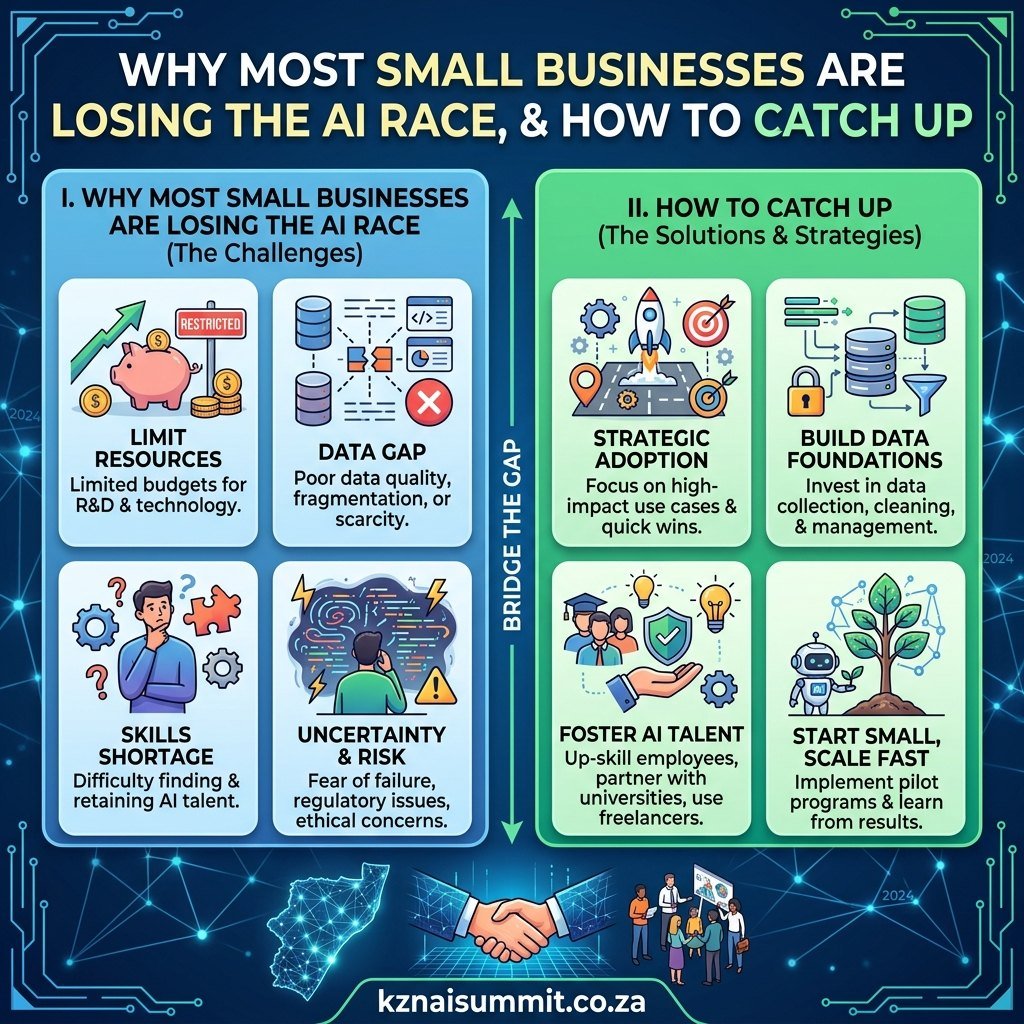
Africa is not short of ambition when it comes to artificial intelligence. It is short of the strategy, data and skills needed to turn that ambition into measurable results — and nowhere is that gap more visible than among small businesses.
South Africa's small businesses are trailing the United States by roughly 50% in AI implementation. Yet the picture is not one of total avoidance: 52% of South African small businesses already use AI tools daily or weekly. The problem sits one level deeper. More than 56% say they need targeted support to use these tools effectively, and 34% describe themselves as overwhelmed by the pace of change and the volume of conflicting advice.
Africa’s small-business AI problem is not simply adoption. It is the gap between using AI and knowing how to use it strategically.
The US Small Business Advantage: Problem First, Technology Second
The businesses winning with AI in the United States are not necessarily the ones with the biggest budgets or the newest tools. They are the ones that start with a specific, costly business problem and work backward to the technology — a problem-first approach, rather than a tool-first one.
Tool-first adoption looks like signing up for the AI product everyone is talking about and hoping a use case appears. Problem-first adoption looks like identifying that customer response times are costing sales, and only then evaluating whether an AI tool actually closes that gap. The order matters more than the technology itself, and it is the single biggest difference between American small businesses pulling ahead and African small businesses treading water.
The Four Barriers Holding African Small Businesses Back
Limited Capital
AI adoption is cheap to start and expensive to sustain. Free tiers and low-cost subscriptions get a business through the first few prompts, but real capability — connecting AI to your actual data, paying for the tools that fit your workflow, or bringing in someone who knows how to implement it properly — needs a budget most small businesses simply do not have.
The result is a ceiling that shows up fast. A small business can experiment with AI for free, but experimenting is not the same as adopting it into how the business actually runs. Without capital for integration, training and the right tools, AI stays a novelty instead of becoming infrastructure.
Weak and Fragmented Data Foundations
AI is only as useful as the data it can see. Many African small businesses run on paper records, scattered spreadsheets, WhatsApp conversations and word-of-mouth knowledge that lives in one person's head — not in a system an AI tool can read, learn from or act on.
This is the barrier that gets the least attention and does the most damage. A business can buy the best AI tool on the market and it will still fail, because there is no clean, structured, accessible data foundation underneath it.
AI inequality is not only about access to technology. It is also about the ability to understand and implement it.
The Skills Gap
Using an AI chatbot is easy. Knowing how to prompt it for a specific business problem, how to evaluate whether its output is actually correct, and how to build it into a repeatable process is a different skill entirely — and it is a skill most small business owners and their teams have never been taught.
- Who on your team actually understands how to get a useful answer out of an AI tool, not just any answer?
- Does anyone check AI output for accuracy before it reaches a customer or a decision?
- If the person who "gets" AI in your business left tomorrow, would that knowledge leave with them?
Africa's small-business AI problem is not simply adoption. It is the gap between using AI and knowing how to use it strategically.
Fear, Confusion and Information Overload
AI is everywhere in the news, and most of the coverage is either hype or horror — job losses on one side, miracle productivity on the other. For a small business owner already stretched thin, that noise is paralysing rather than motivating. Many default to doing nothing at all, worried about getting it wrong, wasting money, or falling for the wrong tool.
That hesitation is understandable, but it carries its own cost. Every month spent waiting for total clarity is a month a competitor spends learning by doing.
How African Small Businesses Can Catch Up
Start With the Problem, Not the Technology
The businesses catching up fastest are not the ones chasing every new AI tool. They are the ones that start with a real, specific problem — slow customer response times, manual admin eating hours every week, inconsistent stock forecasting — and only then ask which tool, if any, actually solves it.
This flips the usual order. Instead of "we should be using AI, what can we use it for," the question becomes "this is costing us time and money, can AI close that gap." That single shift in sequence is what separates adoption that sticks from adoption that fizzles out after a month.
Build Your Data Foundation
Before any AI tool can help, the information it needs has to exist somewhere usable — customer records in one place, sales history that can be exported, inventory numbers that update in real time rather than living in someone's memory. This does not require an expensive system overhaul. It starts with consolidating what already exists and getting disciplined about capturing new information consistently.
Make your business information usable.
Upskill the People You Already Have
Hiring a data scientist is out of reach for most small businesses. Upskilling the people already on the team is not. A staff member who already understands the business, the customers and the day-to-day workflow needs far less training to become the person who owns AI adoption internally than an outside specialist needs to learn the business from scratch.
- Identify one or two people on your team who are curious about AI tools, not just tolerant of them.
- Invest in short, practical training focused on your actual workflows, not generic AI courses.
- Give that person time and authority to test tools on real problems, not just theoretical ones.
Start Small. Prove Value. Then Scale.
The businesses that succeed with AI rarely start with an ambitious, business-wide rollout. They pick one process, one team, one measurable outcome, and prove that AI moves the needle there before expanding. A small, visible win builds the internal confidence and the budget case for the next step.
Africa does not need more businesses simply using AI. Africa needs more businesses creating measurable value with AI.
Closing the Gap Starts at Events Like This
None of these four barriers are unsolvable, and none of these four strategies require a large budget to begin. What they require is exposure to the right thinking, the right peers and the right partners — which is exactly what KZN AI Summit 2026 is built to deliver for KwaZulu-Natal's small business community.