KwaZulu Natal is positioning itself for something much bigger than simply becoming another province that adopts artificial intelligence.
The ambition is clear.
To become South Africa’s biggest AI hub by 2030 and establish KwaZulu Natal as a leading AI innovation region in Africa.
This is not about putting AI into a few government departments, training a handful of people or encouraging businesses to experiment with ChatGPT.
It is about building an ecosystem.
An ecosystem where young people can acquire AI skills, universities can produce research, startups can develop solutions, businesses can adopt AI, investors can find opportunities, government can use technology to improve public services and international technology companies can find a strong African base from which to operate.
The journey has already begun.
The question now is how quickly KwaZulu Natal can turn its ambition into measurable economic impact.
Why KwaZulu Natal?
KwaZulu Natal has many of the ingredients required to build a powerful AI economy.
It has a large population, major universities, TVET institutions, established industries, a significant business community, a major logistics and transport economy, ports, tourism, agriculture, manufacturing and one of Africa's most important metropolitan economies in eThekwini.
It also has something equally important.
A young population that needs access to the skills and opportunities of the next economy.
AI presents an opportunity to connect these existing strengths.
- Imagine an agricultural business using AI to improve crop forecasting.
- Imagine logistics companies using intelligent systems to optimise supply chains.
- Imagine tourism businesses using AI to personalise customer experiences.
- Imagine manufacturers using AI to improve production and predictive maintenance.
- Imagine township entrepreneurs accessing AI tools that allow a small team to compete with much larger companies.
- Imagine universities and TVET colleges producing the next generation of African AI developers, researchers and entrepreneurs.
That is the opportunity.
From 2024 to 2030: Building the Foundations
Becoming an AI hub does not happen because a province declares itself one.
It requires infrastructure, people, businesses, capital, research, partnerships and sustained implementation.
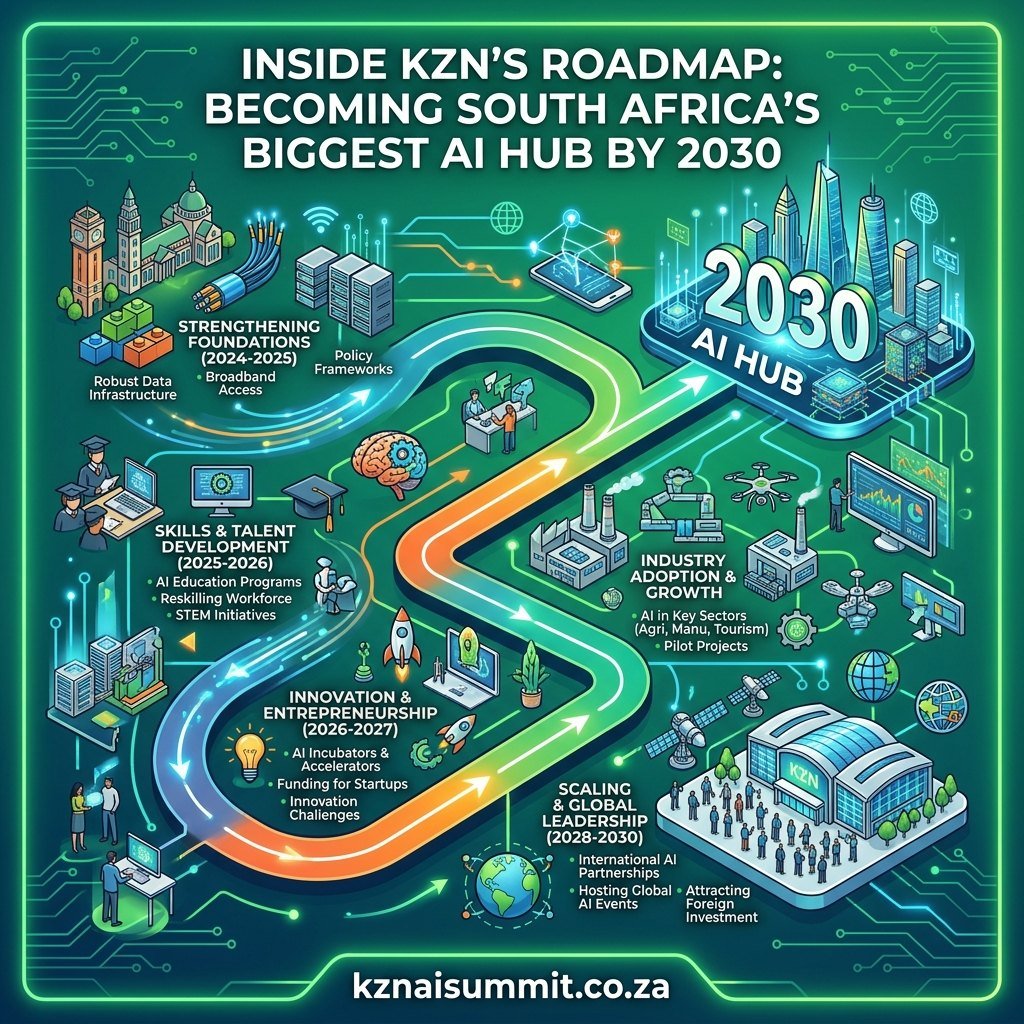
The roadmap towards 2030 can be understood through five important phases.
Building AI Awareness and Capability
The first step is creating awareness.
Businesses need to understand what AI means for their industries. Young people need to understand which careers are emerging. Government officials need to understand how AI can improve public services. Teachers and lecturers need to understand how education must change. Small businesses need practical guidance on how to use AI to improve productivity.
This is where AI education and awareness become critical.
The objective is not to turn everyone into an AI engineer.
It is to create an AI literate society.
A society where people understand what AI can do, where it should be used, what its risks are and how they can participate in the emerging economy.
Developing the Infrastructure
AI requires more than software.
It requires data, connectivity, computing power, cybersecurity, cloud infrastructure and reliable energy.
This makes infrastructure one of the most important parts of KwaZulu Natal's AI ambition.
The province needs an environment where companies can securely process data, develop applications and scale AI solutions.
This also creates opportunities beyond technology.
Energy companies, telecommunications businesses, cloud providers, data centre operators, construction companies and infrastructure investors all have a role to play.
Africa's AI future will depend heavily on whether the continent can build the physical and digital infrastructure required to support it.
KwaZulu Natal can become part of that infrastructure story.
Building the Talent Pipeline
Technology without people does not create an innovation economy.
KwaZulu Natal therefore needs to develop a continuous pipeline of AI talent.
That pipeline must begin in schools and extend through TVET colleges, universities, professional training, research institutions and industry.
But the objective should go beyond producing employees.
KwaZulu Natal should produce AI entrepreneurs, researchers, engineers, innovators and technology leaders.
The province has an opportunity to create pathways where a young person can move from learning AI to building a solution, from building a solution to creating a startup, and from creating a startup to attracting investment and entering new markets.
This is how skills development becomes economic development.
Turning Talent Into Innovation
This is where the ecosystem begins to become commercially powerful.
AI skills need somewhere to go.
Innovation incubators, accelerators, research programmes, university laboratories, startup support programmes and corporate innovation initiatives can provide that environment.
What African problems can our innovators solve with AI? Not simply: which international AI tool can we use?
There is a significant difference.
Africa has challenges that require solutions designed for African realities.
- Healthcare access.
- Agricultural productivity.
- Education.
- Financial inclusion.
- Energy.
- Transport.
- Public services.
- Informal businesses.
- Languages.
- Climate resilience.
- Urban development.
- Cybersecurity.
These challenges represent enormous opportunities for African innovators.
KwaZulu Natal can become a testing ground where local entrepreneurs develop AI solutions that can eventually scale throughout South Africa, SADC and the wider African market.
Connecting KZN to the World
No African AI hub should operate in isolation.
The final stage is global connectivity.
KwaZulu Natal needs partnerships with international technology companies, investors, universities, governments, research institutions and innovation ecosystems.
The objective is not simply to attract foreign companies.
It is to create relationships that result in knowledge transfer, investment, research collaboration, market access and African ownership of intellectual property.
A successful AI hub should create two way value. International partners gain access to African markets and talent. African businesses gain access to technology, investment, expertise and global markets.
That is how a provincial AI ambition can become an international economic platform.
Why This Matters Beyond KwaZulu Natal
The significance of this ambition extends far beyond one province.
Africa is entering the AI economy at a critical moment. The continent cannot afford to become a permanent consumer of technologies developed elsewhere. African countries need to develop their own talent, businesses, research capabilities, infrastructure and intellectual property.
This is why regional cooperation matters.
A successful AI ecosystem in KwaZulu Natal could connect with innovators in Gauteng, the Western Cape and other South African provinces. It could connect with entrepreneurs in Zimbabwe, Zambia, Botswana, Namibia, Mozambique, Tanzania and other SADC markets. It could eventually connect African innovators across the continent.
The opportunity is enormous.
A solution developed by a startup in Durban should not have to remain a Durban solution.
It should be capable of becoming a South African solution. Then a SADC solution. Then an African solution. And potentially a global solution.
The Role of the KZN AI Summit
This is why the KZN AI Summit matters.
A roadmap requires a place where the people responsible for delivering it can meet.
Government needs to meet industry. Industry needs to meet startups. Startups need to meet investors. Universities need to meet technology companies. Young innovators need access to mentors. International partners need to understand what KwaZulu Natal is building.
The Summit provides that platform.
It creates a space for conversations that can move beyond speeches into partnerships, investment, innovation and implementation.
The Summit should therefore not be viewed simply as an annual technology conference.
It is a meeting point for an emerging AI ecosystem.
From KZN to SADC
One of the most exciting opportunities is taking this vision beyond provincial borders.
If KwaZulu Natal wants to become an AI hub, it should also think about how it can contribute to building a stronger SADC AI ecosystem.
The region has enormous human potential.
It has universities, entrepreneurs, businesses, researchers and young people who will increasingly need AI skills and opportunities.
What is missing is greater connectivity between these capabilities.
Regional AI competitions, research partnerships, innovation programmes, startup networks and investment platforms can help change this.
The inaugural SADC AI Hackathon represents exactly the kind of regional collaboration that can help demonstrate what is possible.
Instead of asking which country has the best AI talent, the region should ask: what can SADC’s talent achieve when it works together?
That is a much more powerful question.
The Real Measure of Success
By 2030, the success of KwaZulu Natal's AI ambition should not simply be measured by the number of AI events held or the number of people who attended training programmes.
The real questions should be much bigger.
- How many new AI businesses were created?
- How many jobs were generated?
- How many young people entered AI careers?
- How many startups attracted investment?
- How many businesses successfully adopted AI?
- How much productivity was created?
- How much research was commercialised?
- How many African AI solutions reached international markets?
- How much intellectual property was created locally?
- How many partnerships were established across SADC?
Those are the measures that can turn an AI vision into an economic legacy.
The Opportunity Is Bigger Than 2030
The year 2030 should not be seen as the finish line.
It should be a milestone.
The real ambition is to create an ecosystem capable of continuing to produce talent, companies, research, investment and innovation long after the original roadmap has been completed.
KwaZulu Natal has an opportunity to demonstrate what an African AI region can look like.
- A region where technology is not concentrated only in large corporations.
- A region where small businesses can use AI to become more competitive.
- A region where young people can build careers in emerging technologies.
- A region where universities create commercially relevant research.
- A region where startups can access capital.
- A region where government and industry collaborate.
- A region that develops solutions for African challenges and takes those solutions to the world.
The Race Has Started
The global AI race is already underway.
Countries and regions around the world are investing heavily in talent, infrastructure, research, computing capacity, startups and AI adoption.
Africa cannot afford to wait until the winners have already been decided.
KwaZulu Natal has an opportunity to move with urgency.
Not simply to become South Africa's biggest AI hub.
But to demonstrate how an African region can transform itself into a centre of AI talent, innovation, entrepreneurship and investment.
The question is no longer whether AI will transform KwaZulu Natal.
The question is whether KwaZulu Natal will help shape how AI transforms Africa.
And that conversation starts with bringing the right people into the same room.
Government. Industry. Academia. Startups. Investors. Young innovators. International partners.
That is the purpose of the KZN AI Summit.
The future will not wait until 2030. We have to start building it now.